Why Large-Scale Public Sector IT Modernization Fails — And What It Takes to Get It Right
The list of large-scale HHS IT modernization programs that have struggled, stalled, or collapsed outright is long. SNAP implementations that made it all the way to UAT before funding fell through. Child welfare systems that unraveled under the weight of immature technology and misaligned expectations. Integrated eligibility programs that limped along for years past the point where anyone could honestly call them on track.
At D2Sol we’ve seen this pattern up close. Not just as observers, but as practitioners who have worked through successful implementations in multiple states and territories, and who have watched from the sidelines when things went wrong elsewhere. The failures are rarely mysterious. They follow a pattern the industry understands and too rarely talks about directly.
Here’s what that pattern looks like.
Scope set by political moment, not technical reality. New administrations, federal deadlines, and high-profile audit findings create pressure to commit to massive multi-program replacements before the hard discovery work has been done. The ambition is real. The planning behind it usually isn’t.
Requirements written before anyone understands the problem. Procurement law forces RFPs before discovery happens. The winning vendor spends the first 18 months figuring out what the state actually needs. By then the baseline schedule is already broken.
Fixed-price contracts that work against delivery. States underprice to satisfy oversight bodies. Vendors underbid to win. Then both sides spend years fighting over change orders instead of building the system. The contract structure becomes the enemy of progress.
States that can’t be good clients. Decades of outsourcing have hollowed out internal IT capacity. The institutional knowledge of how legacy systems actually work has retired or walked out the door. States end up dependent on the vendors they’re supposed to be managing, and experienced vendors know how to operate in that environment in ways that don’t always serve the state’s interests.
Legacy systems that are more complex than anyone admits. Thirty or forty years of patches, workarounds, and undocumented policy exceptions don’t show up in the requirements document. They show up in testing. Sometimes in production. Each one is a delay. Together they can add years. This is where firms with deep legacy extraction and data conversion experience earn their place at the table.
Governance that cannot make decisions. Multiple agencies, multiple levels of government, multiple federal partners, each with a stake and none with clear authority. The program stalls not from technical failure but from institutional friction that nobody designed a solution for.
Waterfall delivery in a world that demands agility. Policy changes constantly. A new federal rule, a court settlement, a legislative session. Any of these can invalidate design decisions made 18 months earlier. Modular, iterative delivery isn’t just a preference anymore. It’s a survival strategy.
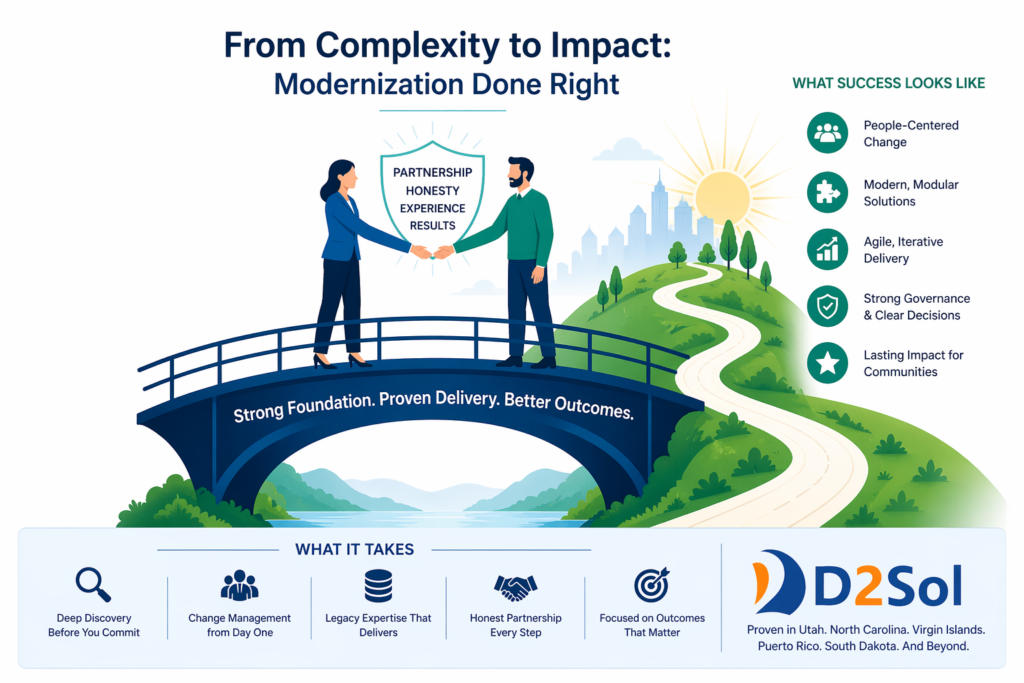
Change management is not a go-live activity — and treating it like one is one of the most common ways programs fail. We have seen technically sound implementations stumble badly because OCM was treated as a training event scheduled six months before go-live. That is not change management. Real OCM starts on day one. It starts when the project starts. It means sitting with the people whose jobs are about to change before a single requirement is written, understanding their workflows, their fears, their workarounds, and building a sustained engagement strategy that carries them all the way through and beyond go-live. Frontline eligibility workers and caseworkers are not an afterthought. They are the system. If they are not ready, informed, and supported, it doesn’t matter how clean the architecture is. The program will struggle. At D2Sol, OCM is not a workstream we add to the project plan. It is part of the foundation we build from.
Federal funding that distorts decision-making. Enhanced match rates make ambitious projects look affordable. This encourages over-engineering and gold-plating. When funding conditions shift, states find themselves exposed on programs they scaled up assuming the dollars would always be there.
No real accountability when things go wrong. Directors rotate. Administrations change. The team that sold the project is long gone by the time problems surface. Projects limp along for years past the point of honest reckoning.
The pattern underneath all of it is a gap. Between the formal version of the project and the actual state of affairs. Status reports that say yellow when everyone in the room knows it’s red. Governance meetings where the hard questions don’t get asked. That gap widens slowly until it can’t be ignored.
Most large program failures aren’t surprises. They’re slow-motion events that people could see coming.
What changes that pattern isn’t a bigger team or a shinier platform. It’s partners who are honest about complexity before the contract is signed, who treat OCM as a foundation rather than a finishing touch, who have done the legacy extraction work that nobody glamorizes, and who know what good delivery actually looks like because they’ve been part of it. In Utah, in North Carolina, in the Virgin Islands, in Puerto Rico, in South Dakota, and in the states still working toward it.
That’s the work D2Sol was built to do.