
What Actually Fixes Large-Scale Public Sector IT Modernization — A View From Someone Who Has Seen Both Sides
I spent the last post talking about why these programs fail. I’ve watched it happen more times than I care to count, from the inside and from the sidelines. But I’ve also watched things go right. And after 25 years in this space, I have a pretty clear picture of what the difference looks like.
It is not the methodology. It is not the platform. It is not the size of the SI or the sophistication of the contract structure.
It is collaboration. Real collaboration. The kind that is harder to procure than any technology and rarer than it should be.
Here is what I mean by that, and here is what I think it actually takes to fix the patterns I described.
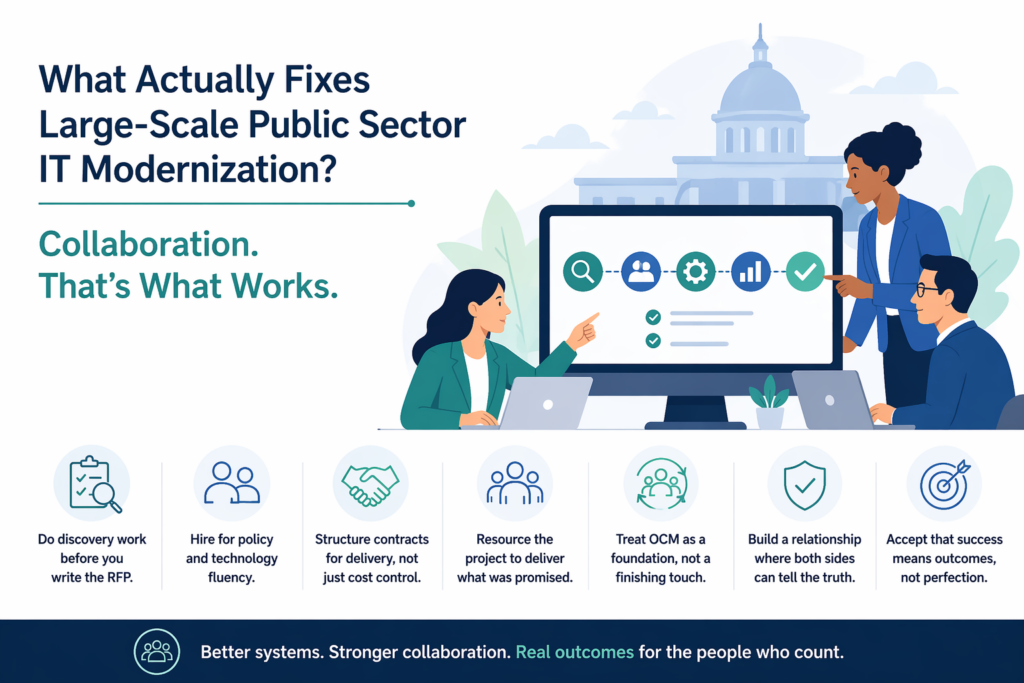
Do the discovery work before you write the RFP. States that succeed invest time upfront understanding what they actually have before they ask vendors to propose replacing it. That means mapping current workflows honestly, not the ideal state workflows, the real ones. It means identifying the policy exceptions that have been hard-coded for decades. It means finding out who the one person is who knows the legacy system and making sure their knowledge gets documented before the project starts. This work is not glamorous. It is not billable to a federal match. But it is the difference between a requirements document that reflects reality and one that reflects wishful thinking.
Hire for policy and technology fluency, not just one or the other. The requirements gap closes when you have people in the room who can hold both conversations at once. People who understand what a federal regulation actually requires and what it takes to build a system that satisfies it. Those people exist. They are not always the loudest voices in a procurement process, but they are the ones who catch the contradictions before they become change orders.
Structure contracts for delivery, not just cost control. Fixed-price contracts feel safe to oversight bodies but they create incentives that work against the project. States that succeed find ways to build in flexibility, whether through modular procurement, time and materials components for discovery phases, or contract structures that reward delivery milestones rather than just penalizing overruns. The goal is a contract that makes both sides want the same thing. That sounds obvious. It is surprisingly rare.
Resource the project to deliver what was promised. If you underbid to win the work, you have an obligation to make up the difference on the delivery side. The firms I have seen do this well treat the delta between sales price and true cost as a strategic investment in the relationship and in their own reputation. The firms that don’t are the ones whose projects end up in the news.
Treat OCM as a foundation, not a finishing touch. The projects that worked had change management woven into the fabric of the work from day one. Not a training plan. Not a communication strategy drafted six months before go-live. A genuine, sustained effort to understand what was changing for workers and clients, whether that was the technology, the process, or the organization itself, and to bring people along at every level. The state has to be willing to look honestly at organizational and procedural dysfunction that predates the project. A new system will not fix a broken culture. But a team that is honest about that early enough can help the state address it before it derails the implementation.
Build a relationship where both sides can tell the truth. This is the one that is hardest to put in a contract and the one that matters most. The implementations I have been part of that succeeded had a quality that is difficult to describe but easy to recognize when you are in it. The state could tell the vendor when something wasn’t working without it turning into a legal dispute. The vendor could flag a risk early without worrying that it would be used against them in a performance review. Both sides could say “this isn’t right, let’s figure it out” and mean it. That kind of relationship doesn’t happen by accident. It gets built deliberately, in small moments, over time, by people on both sides who decide that getting to the right outcome matters more than being right.
Accept that success means outcomes, not perfection. The successful implementations I have been part of were not perfect. There were bumps, delays, and moments of real frustration. But the state got to a place where caseworkers could do their jobs, clients could access services, and the program could move forward. That is the bar. Not a flawless go-live. Not a system that does everything the Ferrari-wishing SME described in year one. A system that works, that serves people, and that can be improved over time.
I was a caseworker before I was a consultant. I have never forgotten what it feels like to be on the front line of these programs, trying to help a family navigate a system that was not designed with them in mind. And I have never forgotten what it feels like to watch a system fail the people it was built to serve.
The fixes are not mysteries. We know what works. The question, as always, is whether the people with the authority to make different decisions are willing to make them.