Five Trends Reshaping Health and Human Services IT And Why This Moment Demands a Different Kind of Partner
The Health and Human Services IT landscape is shifting in ways we haven’t seen in nearly three decades. Not incrementally. Not as another wave of federal mandates that states absorb and adapt to. This feels more fundamental than and more like the rewiring that followed PRWORA (Personal Responsibility and Work Opportunity Reconciliation Act of 1996) than anything that has come since.
At D2Sol we’ve been in this space long enough to know the difference between a trend and a transformation. We’ve done the data conversions that keep the lights on during go-live. We’ve run the M&O operations that nobody writes press releases about. We’ve lived inside legacy systems long enough to understand exactly why modernization is harder than it looks from the outside.
Here’s what we’re seeing right now, and why it matters.
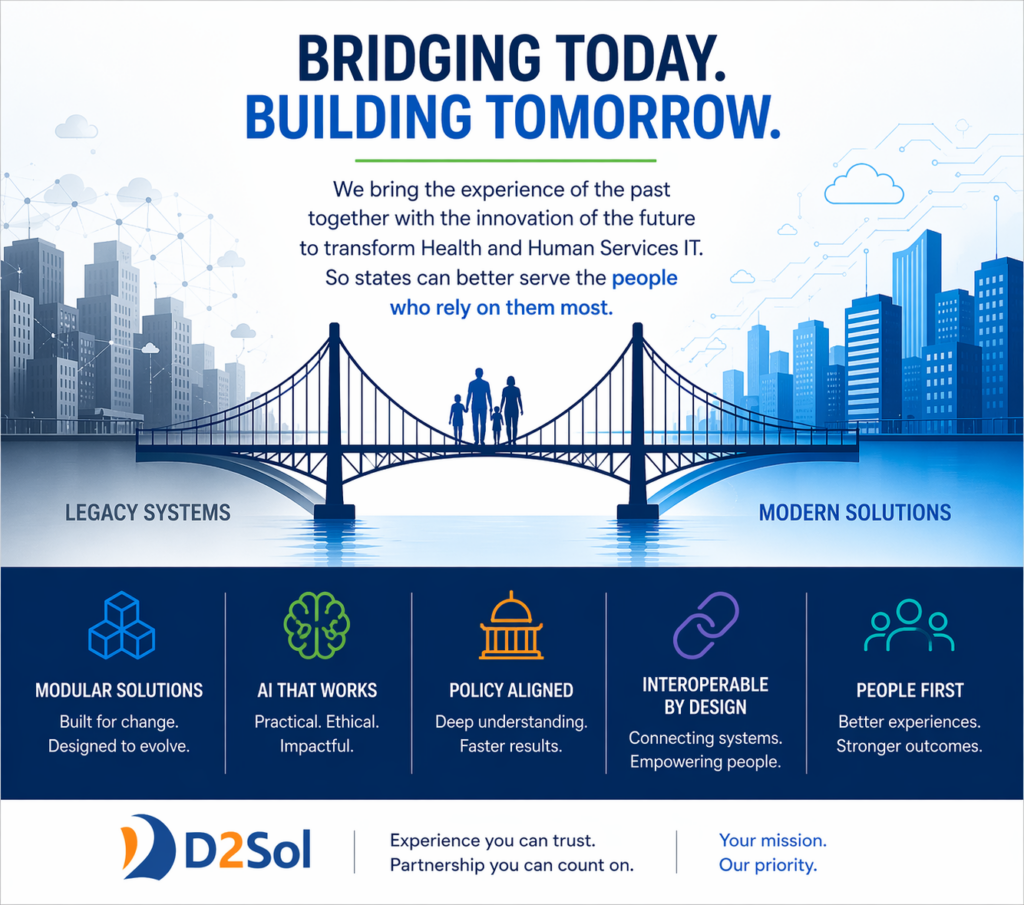
- Modular is no longer a preference; it’s a mandate. States are done with 10-year monolithic builds. CCWIS regulations require modularity, reusability, and continuous improvement, and procurement strategies are following suit. The firms positioned to win aren’t the ones showing up with the biggest team they’re the ones showing up with reusable accelerators and a delivery model built for continuous enhancement. D2Sol is building exactly that.
- AI is moving from pilot to procurement requirement. The use cases in this space aren’t abstract. Caseworkers drowning in documentation. Eligibility determinations that take longer than they should. Document classification that still happens manually. AI is showing up in RFP evaluation criteria now, and the firms that have been closest to the actual workflow not just the architecture are best positioned to build tools that work in practice, not just in demos.
- Federal policy is creating massive system demand. Medicaid work requirements, redetermination complexity, FFPSA compliance, HR-1 every federal mandate creates ripple effects across integrated systems. States need partners who understand both the policy and the technology deeply enough to move fast without breaking things. That combination is rarer than it should be.
- Interoperability is finally being taken seriously. For years, “integrated eligibility” described an aspiration more than a reality. That’s changing. States are investing in master person indexes, API gateways, and enterprise data platforms. The firms that have spent years doing the hard work of legacy extraction and data migration, the work that makes true interoperability possible, have an advantage here that is easy to underestimate.
- Workers and clients are finally being treated as users. The gap between consumer technology and government systems has been embarrassing for a long time. Someone who is hungry, scared, or navigating a family crisis shouldn’t have to fight the interface to get help. And a caseworker shouldn’t need weeks of training just to navigate a platform. The push toward mobile capability, user-centered design, and genuine self-service is long overdue — and it requires partners who understand the workflow from the inside, not just the screen.
Here’s what ties all five trends together: states don’t just need vendors who can build new things. They need partners who understand what exists, why it was built that way, and how to move forward without leaving mission-critical operations exposed in the process.
D2Sol is a younger firm. We don’t have decades behind our letterhead. What we do have is a team of practitioners who collectively carry that decades of experience people who have done data conversions, run help desks, written RFP responses, sat in war rooms, and worked directly with state staff across multiple states and territories before they ever joined this firm. We didn’t grow up inside a big SI. We came from the work itself. And in a moment that looks and feels like PRWORA where the frame is changing, not just the rules, that kind of experience is exactly what states need in the room.