
When a Policy Changes, How Many Letters Have to Change With It?
For an agency correspondence team, a policy update can set off a surprisingly long chain of work.
Find the affected templates. Check which programs use them. Confirm the wording with policy specialists. Coordinate legal review. Update language versions. Test the different scenarios. Get approval. Make sure the right version reaches the right person.
And somewhere along the way, someone asks: “Are we sure we found every version?”
That question captures much of the challenge with correspondence in HHS agencies and health programs. The work is essential, the details matter, and the process behind it can be harder to manage than it should be.
At D2Sol, we’ve worked through these situations time and again alongside our clients. Those experiences are now coming together in D2Sol CorrespondenceIQ.
The letter is only the visible part
An eligibility decision, renewal request or benefit change may look like a straightforward document. Behind it are policy decisions, case data, content variations, approvals and delivery requirements.
For the person receiving it, the questions are much simpler: What does this mean for me? What do I need to do? By when?
A confusing communication can leave someone unsure whether their benefits have changed or which documents they need to provide. That uncertainty can also come back to the agency through calls, follow-ups and additional casework.
Correspondence deserves attention as part of service delivery. Clear, relevant information helps people act and helps agency teams support them.
When a manageable template library becomes difficult to maintain
Many teams will recognize how it happens.
A standard letter needs a variation for another program. A second version needs a different contact number. Another requires an additional explanation or enclosure.
Each change makes sense at the time. Over the years, the library grows. Eventually, teams may be maintaining separate documents that share most of their content. A routine update becomes an exercise in finding copies, comparing wording and checking that nothing was missed.
One of the goals behind CorrespondenceIQ is to make those variations easier to manage.
Configurable starter templates give teams a head start. Shared content and approved assets reduce repeated work. Business rules determine which information belongs in a particular communication. Teams can adapt correspondence to the program, policy and recipient while maintaining a common foundation.
Built from work we have already been doing
CorrespondenceIQ did not begin with a blank sheet of paper.
Over years of client work, D2Sol developed reusable correspondence assets: templates, content components, rules and workflows that could be adapted to different customer situations with limited modification.
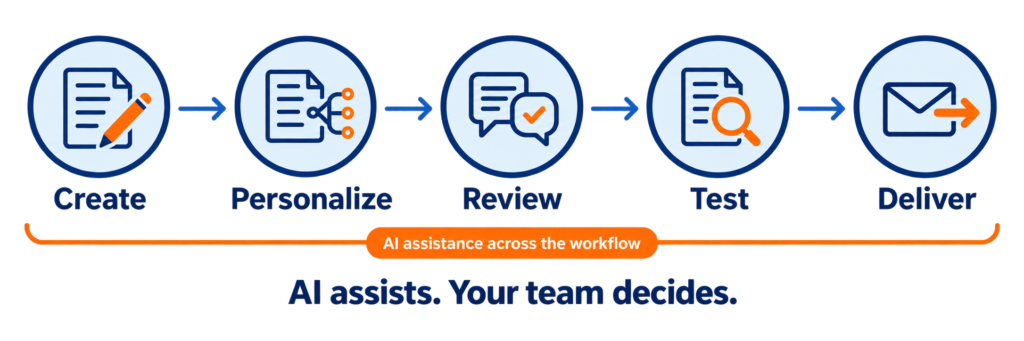
We kept seeing opportunities to reuse what worked. We also saw the value of connecting those capabilities more closely. That is what we are now productizing under the CorrespondenceIQ banner: a connected experience from content preparation and personalization through review, testing and delivery.
AI has helped us find new ways to bring that experience together.
Where AI can make the work easier
For agency teams, the useful question about AI is practical:
Which parts of my work will it help me get through?
Consider a few examples.
Moving existing correspondence into a managed workspace.
AI can suggest content mappings, identify reusable elements and help teams review extracted variables and rules. This gives reviewers a starting point when working through an existing document collection.
Turning policy intent into business logic.
AI can help translate a business requirement into suggested rules and explain the conditions in language reviewers can understand.
Working out what to test.
Teams can use AI assistance to suggest scenarios involving missing data, thresholds and different recipient circumstances—variations that are easy to overlook when everyone is working toward a deadline.
Understanding an unexpected result.
When a bulk test produces missing content or an unusual output, AI can help reviewers investigate using the available test evidence.
Preparing content for review and translation.
AI can summarize changes, help make reviewer feedback actionable and assist with language preparation.
Across these activities, the principle is consistent: AI assists. Your team decides.
People review suggestions, confirm changes and remain responsible for approval.
More control for business teams, with review built in
Agency teams need to respond to change. They also need confidence that changes have been reviewed by the right people.
CorrespondenceIQ gives business users a familiar authoring experience for everyday content updates, supported by configurable review and approval workflows.
Authors, policy specialists, legal teams and approvers can contribute through a coordinated process. An audit trail records changes and approvals so teams can understand how a communication reached its final form.
Representative test data and output previews help reviewers check how content behaves across different situations before release.
The aim is to make everyday work easier while keeping accountability visible.
Think about the person opening the communication
A document can contain the correct information and still be difficult to use.
Recipients may need another language, an accessible format or a different way to receive and access their correspondence.
CorrespondenceIQ supports accessible document preparation and checks against agreed standards. AI-assisted translation works alongside human review to help teams prepare language versions for their audiences.
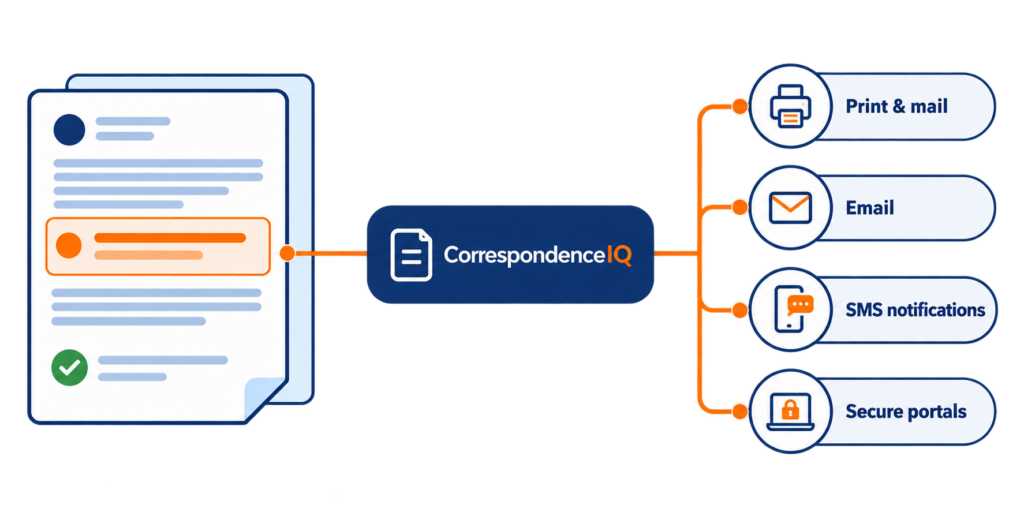
Approved communications can connect with print and mail, email, SMS notifications and secure portals through the organization’s delivery services and integrations. Delivery choices can reflect recipient preferences, consent and the purpose of the communication.
An SMS alert might direct someone to a document in a secure portal. Another recipient may need printed correspondence. Those choices belong in the design of the service.
A more manageable response to the next policy change
Agency teams already understand the importance of correspondence. They live with the deadlines, exceptions and consequences every day.
What they need is a more connected way to manage the work:
-
- Fewer copies of the same content to maintain.
- Less rebuilding when a program or policy changes.
- Clearer coordination across reviewers.
- Better support for testing meaningful variations.
- A traceable path from approved content to delivery.
That is the direction we are taking with D2Sol CorrespondenceIQ – bringing years of practical experience and reusable capabilities together with AI assistance across the workflow. So, when the next policy update arrives, teams have a better starting point and more confidence in what happens next.
D2Sol CorrespondenceIQ is coming soon. Stay tuned !!